
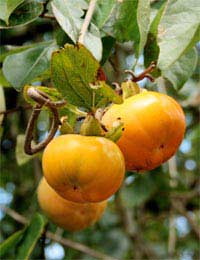
Q.What causes an orange tree to turn sour, with a thick bumpy skin? Can it be fixed?
(Linda Hutcheson, 5 December 2008)
A.Thanks for your question. Sweet oranges can be difficult to grow in this country – they’re native to Mediterranean climates, where they grow on warm southern slopes in Italy and Spain. Orange trees are susceptible to frost, so they must be brought indoors before any risk of frost (late October in the South; check online for last frost dates in your region). Summer fertiliser helps to improve the fruiting quality. Once fruits form, they can take up to a year to be ready for eating; the orange tree has a very long ripening period, so it could be that your fruits just need a little longer on the tree.
It could simply be that your orange tree has not had enough sunshine for its fruits to fully ripen this year. In 2008 many crops suffered from the lack of long, sunny days at the end of summer: squash and corn, two other warm-climate crops, did not fully ripen for many British growers (even the professionals!). Orange trees don’t fare well outdoors in Britain – except for a few notable exceptions on the far South coast, where conditions are more Mediterranean. Orange trees like a warm, humid atmosphere to produce the best fruit, and this is not typical of our British summers. As a result it’s best to bring the plant in to a conservatory or warm window as autumn arrives, to give it plenty of sunshine without chill. Orange trees like a minimum temperature of 13 degrees C during the winter, so pick a good spot for the best chance of survival.
You should also water and feed your orange tree occasionally in the summer (once a week with a citrus fertiliser) but look out for overwatering – leaves will droop or turn yellow.
If you’d like to try again with a reliably sweet orange, the RHS recommends Valencia (citrus sinensis) for eating (follow the care tips above). There are many varieties of bitter orange too – don’t discard the fruit, though – they’ll make great marmalade!
For lots more information about growing oranges, lemons and other fruit, check out the navigation menu on the left hand side of this page.

I HAVE A NAVEL ORANGE TREE THAT WAS NEGLECTED WHEN I WAS IN REHAB. NO ONE WATERED IT. IT HAS LOST ALL THE LEAVES ON BRANCHES, BUT HAS SOME LOWER DOWN. ALSO HAS A NEW SPROUT ON TRUNK. CAN I SAVE THIS TREE, AND HOW?
I purchased an orange tree (Five years old) growing in a pot, all was well it flowered wonderfully but alas due to some strong winds I ended up with only four oranges growing. They have reach the size of a small lemon when It started to dramatically drop its leaves even though there was new leaf growing from the main steam, I also had a problem with grasshoppers eating the leaves but it all seemed fine until all the oranges dropped off one by one and now some of the branches are dead. I scraped them back and under the outside bark they are brown and not healthy green. I do not know what has caused the problem. I live on the Costa Blanca and the tree is in a very sunny position, I only watered it when after inserting my finger into the soil it felt dry. Can I save the tree for next year or is it a goner? thanks
I had my orange tree since 1993 & it has never grown any oranges & the leafs keep dying
Please help!!! We just purchased a home last December in Bakersfield Ca. and it has a orange tree in back yard. Last year only a couple if oranges were on it. This year we got a lot on the tree however the oranges are very bumpy and have seeds. We are not sure how to tell when they are ripe or if it is normal for them to be bumpy. Last year I tasted one and thought it was sweet but my husband just picked one off the tree that was all orange and it was very sour and when he was peeling it the juice looked kinda green. If anyone knows about what kind of orang e this could be please help why so bumpy ????
@sweet oranges – The fruit will turn completely orange and have lost their green when they are ripe. AS you have recently bought your home, it might be worth beginning some proper care for your tree in order to get the best fruit. It might be that it has been neglected. If you look at the orange trees in Europe; Spain and Italy the fruit is usually bumpy and misshapen, but it tastes fine.
I have 2 plum trees I have had for 3 years now and nothing on any of them also a cherry tree that only has a few cherries on it what am I doing wrong
last year I put a very small orange tree and lemon tree in the garden and covered them to protect them from the frost, both survived – though the orange did a lot better than the lemon – last winter was quite mild – sould I put them in pots and in the greenhouse for the winter – or just cover them again – I dont want to lose them now. proopsie
I have a orange tree in a container here in Indiana, I have notice on some of the new leaves there is a chain of something that look like eggs that is covered with clear substance , what is this and what can I do to treat it pls thanks
i have a orange tree for a week and all in a sodent it lossing leave i dont know why can you tell me please thank you pya
I have a smal/minaturel orange tree bought from a garden centre in Cornwall. It was in their greenhouse and I have always kept it indoors. It is now five years old and has regularly produced blossom and mini oranges – but this year the leaves are all drooped and quite brittle and I am worried it is dying. No flowers or oranges. It is kept on a windowsill which gets some sun in the morning but is still light during the day. I normally use a citrus food product, but haven’t recently but can’t imagine that is the problem? I have re-potted the tree once – about 2 yrs ago – using a citrus compost, and it carried on flowering, etc quite happily. Any advice you can give me would be much appreciated. many thanks, Annie
I have white spots covering most of the wooded part (trunk and branches) of my washington navel tree with some of the branches spliting, is there something I can spray it with, the tree is 20 years old
My orange tree had no blossoms this year for the first time. The tree is appox 20 yrs old. I think it is a navel as the fruit has a small belly button. We had lots of fruit this winter and especially good. I fertilize 3 times a year. The leaves are green and turned upward. The tree appears healthy. We usually get the blossoms in march and fruit in November. Can you give some advice? thanks , jan