
The pear tree is widely cultivated across the world. Its fruit is juicier than that of apple trees and it is generally softer in texture. The fruits can be eaten raw, used in cooking, juiced, or made into cider or perry – a traditional alcoholic drink made with fruit of pear trees grown in south west England.
Jump To...
About Growing Pear Trees
The pear tree belongs in the same plant family as the apple tree (Maloideae, a subfamily within Rosaceae), and bears similar blossom to its cousin.
The small white flowers bloom in early spring. Pear trees in the UK are deciduous so lose all their leaves during the autumn months.
Pears are ready to harvest by October and these trees produce their blossom in early spring. The flowers are white, although some feature a yellow or pink tint. The fruit shape differs across the world, but in the UK and Europe the classic shape is that of an oval with a bulbous end.
Pear trees can grow as big as 7 or 8 metres if you grow from seed but the average garden-sized tree grows to around 3 to 4 metres. They normally have a tall, narrow crown, although a few species are shrubby. With interest in compact varieties growing, there are now many much smaller pear trees which may be suitable if you have less space.
Dwarf pear trees can be grown in small gardens or large pots, whilst patio pear trees will provide a small but perfectly formed orchard without a garden at all!
Types of Pear Tree in the UK
The breeding of pears has not been carried out on such a large scale as apples. Some new varieties have been introduced, however, including the Bristol Cross and the Merton Pride.
They can be largely classed into two varieties: cooking or dessert pears.
Virtually half of Britain’s pear orchards have been destroyed since 1970. This has resulted in the reduction of many cultivars, including the oddly named Vicar of Winkfield, which had pale yellow flesh and is firm, dry and woolly in texture. This variety can still be bought to order from specialist suppliers, but is no longer grown commercially.
Popular Varieties of Pear Include:
Concorde – self fertile new variety. Taste is similar to the Comice pear but it is much easier to grow Conference – well-known, reliable pear, most common variety grown commercially Worcester Black – originates in Worcestershire in the 16th Century
Pear Tree Identification – What Type of Tree Do You Have?
It’s not unusual to inherit a pear tree when moving house. If you’re lucky enough to have found a fruiting tree in your new property, you might like to identify which variety of tree it is. Might it be ornamental or will it produce edible fruit? You might also not be sure if the tree in your garden is an apple or a pear. Their blossom is very similar, and until you see fruit you might not be able to tell.
Do I Have An Apple Tree or A Pear Tree?
There’s a number of things you can look at to try and identify whether your tree is an apple or a pear. Our quick guide takes a look at what a pear tree looks like at key growth stages.
Pear Leaves
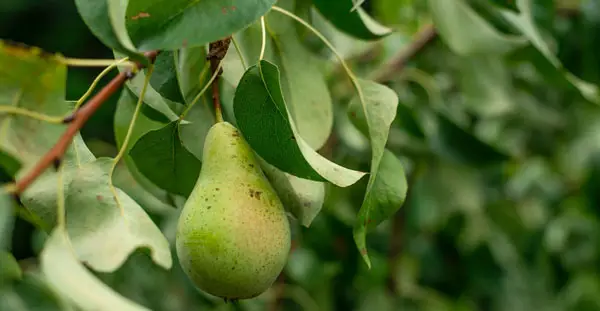
The leaves of a pear tree are broad and flat in appearance. They have a rounded base and a serrated edge that looks like double teeth. You’re looking for saw like serrations arranged in distinct pairs. Glossy on top and smooth underneath, the leaves grow singly on the stems coming from the branch.
Pear Bark
For identification purposes, you need to check the colour and texture of bark on your fruit tree. Pear bark on a young tree will be smooth, whilst a more mature tree will develop a rougher texture as it ages. Bark colour will be grey-brown.
Pear Blossom
If your tree is in blossom, you can check for subtle differences that let you know if it is an apple or a pear tree. A pear tree will have have small white blossom with five petals. An apple tree tends to have blossom with a slightly pink hue, whilst pears will be pure white.
Pear Fruit
Whilst pear fruit is still small, it can look quite similar to that of the apple. If you check the texture and find it to be rough, you’ve got a pear. Smooth fruit indicates an apple tree!
What Type of Pear Tree Do I Have?
If you already know your fruit tree is going to produce pears, but aren’t sure which variety it is it can be difficult to identify. It’s probably easiest to wait until your tree has produced fruit before using an online pear identification guide to work out what type you have.
If you have an ornamental pear tree which has been cultivated purely for it’s blossom, your first clue will be the huge amount of blossom the tree will produce. Some ornamental varieties also have a distinct smell which may not be all that pleasant. If your blossom smells a bit fishy, you are unlikely to get any fruit from your tree. Finally, an ornamental tree will produce small brown fruit. The fruit of the ornamental pear tree will be edible, it just won’t taste great. Probably best to leave them for the birds.
How To Grow Pear Trees
Although a fairly robust and hardy tree, pear trees still need care and attention over the the year for healthy growth. It’s this care that will give you a well established and reliable crop each year. Pear trees are easy to establish which goes some way to explaining why so many of them exist across wild parts of the UK. They are also common in gardens due to their low-maintenance nature.
Pear trees can be grown in orchards, large pots or as espalier trees against a wall or trellis. Like apple trees, if you choose to grow your own pears you will need at least two trees to ensure the flowers are fertilised to produce fruit.
For espalier-trained trees you can buy a year-old tree and train it yourself, by pruning the branches so the tree grows flat against the wall in a fan shape or along horizontal lines. You can also buy trees that are two or three years old and already trained. This will have the additional advantage of bearing fruit more quickly.
When To Plant Pear Trees
Getting the timing right in regards to planting a pear tree is key to successful growing. If your pear tree is in a pot you can pretty much plant it any time of the year – winter is best however. For bare-root stock, you need to plant trees between Autumn and early Spring.
Where To Plant Pear Trees
Pears need plenty of sun, plenty of shelter, and wherever possible, plant pear trees higher up to reduce the risk of frost damage. They prefer well-drained soil that isn’t too shallow. South-facing is the perfect location for your pear tree and they don’t do well in areas susceptible to waterlogging. Pears should be placed roughly 10m apart, although dwarf trees can be spaced just 6m apart.
How To Plant a Pear Tree
It’s relatively easy to plant a pear tree. Dig a hole, a little wider and deeper than the roots of the young tree. Part-fill it with home-grown compost and place the roots in it. Tie the tree to a support and fill in the hole with soil, firming gently. Water well, and ensure it is well watered during dry spells. You should have pears within two years.
Pear trees provide years of fresh fruit, and there are so many varieties available that you can’t buy commercially. If you have room, treat yourself to one or two heritage varieties, they’ll provide interest as well as delicious fruit.
How To Prune Pear Trees
Pruning is so important for your pear tree’s health and this should take place twice a year. Pruning of a pear tree should first occur in winter, and the task is to ensure only healthy branches remain on the tree. You should also ensure any over-crowding is dealt with at this time. You can also cut back branches by around a third of their length. In the summer any pruning you do should concentrate on allowing the fruit to be well exposed for optimal growth.
When To Harvest Pear Trees
Pears can be harvested around September / October time and the fruit should be picked before becoming soft. Pears like a period of storage before being eaten and this makes for a nicer tasting fruit. Early pear varieties will be best eaten a week after picking whereas later varieties can last a few months in storage. Varieties include Conference, Worcester Black, and Concorde.
Cultivating Pear Trees
Cultivated pears are derived from a handful of wild species distributed throughout Europe and western Asia. In England the trees can often be found growing wild, where seeds are spread by birds or mammals that have eaten the fruit.
The pear is very similar to the apple tree in cultivation, propagation and pollination. It is normally reproduced by grafting. This process involves growing a tree from seed, and grafting the cutting of another variety on to it. This maintains the specific type of pear grown, as those trees grown from seed can produce a lower quality of pear, and often an entirely new species.
Pear trees are naturally very deep rooting. As such they suit a light, sandy soil. However many pear cuttings are grafted onto quince trees, which are more shallow rooted. These are more suited to growing in large pots and damp, clay soils.
How to Choose Your Pear Tree
Before buying your pear tree, consider what size (height and spread) is appropriate for your garden. The size of the tree can be determined by its rootstock (the lower part of the tree on to which different varieties are grafted). If its rootstock is a traditional pear variety it will need more room than if the tree is grafted on to quince stock. The label should also tell you how fast the tree grows and how high.
Pear FAQ’s
If you’re interested in growing pears in your fruit garden, our pear knowledgebase covers off many of the frequently asked questions about this versatile fruit.
The size will come down to how your pear tree was planted and how well it grows in your chosen spot. Generally speaking, a bush-shaped garden pear tree will grow to around 3 to 4 metres. However, one grown from seed can be much less predictable and can be as big as 8 metres tall – yep, ladders will be required for harvesting!
Fruit will normally grow on your pear tree during its 4th year but it depends on the rootstock used.
There are a few pear tree varieties that are partly self-pollinating , including conference pears. However, they all do best when supported by another tree to allow a fuller crop to be produced. It’s important to pick two trees that flower at the same time when pollinating your pear tree.
Pear pips should be popped inside a resealable bag with some potting soil and then refrigerated for 4 months. Seeds should be kept moist but not wet and this process will mimic the winter season. When you’ve taken the pips out of the fridge you can then pot them about 1 inch deep. Pop one pip in each pot and then put them in a warm and sunny location indoors. Once they begin to germinate and have grown to a decent height, you can plant outdoors.
In the UK, Quince A rootstock is most widely used for grafting pears. Grafting pears provides the best results in terms of the fruit crop.
Although pretty in bloom, pear trees don’t all smell as nice as they look – in fact, some just quite simply stink! In the UK, Plymouth Pear trees can have an unpleasant odour and you can usually smell them from afar. The smelliest pear tree is the Bradford pear tree, whose odour is described as fishy, however, these aren’t grown in the UK.
Once you have your glorious crop of pears, you’ll need our pear recipes to use up your glut of fruit!

The top branches/leaves of my pear tree show signs of being eaten as they have many holes in these top leaves but I cannot see any insects/grubs, have you any advice. my pear trees only provide 3 to 4 fruit each year, they are more round like apples and always very hard, should I pick them and let them ripen off the tree.
HArd and round? looks like it is a WILD or rootstock Pear – we have them too after the rabbits had their fill of treebark, encouraging the rootstock to take over.
Has anyone ever heard of a ‘croft’ variety pear tree…once grown in Surrey in the late 1800s-1930s ? I am trying to find any information about this variety.
To get better pears how many pears should you keep on one branch,do i take the smallest pears off so the two remaining grow better.
We planted a pear beurre hardy about four years ago. It was grafted on to quince A rootstock. Can the quince have taken over? The tree looks like a bush, bristling with branches but I think only one clear pear stem (lighter green, slightly shiny leaves with a red spot or two on a few of them) of the three main stems rising from the base. Is this possible and can I cut off everything that isn’t the pear? Those leaves are darker green, not shiny. I would be incredibly grateful for advice, thank you.
My two year old pear tree which I am training on a fence looked great in the spring. Since then all the fruit has fallen off and the leaves have turned black and withered. At first I thaught it may be dry so have watered it regularly. Can it be saved.??
I av a patio peach tree in a tub it is just getting its new leaves but at the base it is getting green shoots what do i do with them
The reason why pears aren’t setting is that no pear is truly self fertile so you need another variety of compatible pear tree to yours and pollinate each other. A William’s pear would be ideal with the conference variety.
I have a 5 year Conference Pear Tree that has never produced fruit. This year, had a few pears, but they soon fell and I was left with no fruit. However, since last year, it has flowered ALSO in July, which is odd. I have removed all the flowers, but would like to know what is wrong with my tree please. Thanks
I have a conference pear with about 6 pears on. Its july but its now showing signs of producing more blossom is this usual
I have a single self-pollinating pear tree which has blossomed beautifully for the past three years but no fruits. The tree is now 5-6years old. This year there saw the best blossoms so far, however the flowers turn brown/black and fall from the tree in the slightest of breezes. What is wrong with the tree and how can I correct it?
I have a 3yr old conference pear tree. It blossoms well. The leaves are healthy. But as soon as the fruit starts to set it drops every on. I have not had a single pear mature. It is (self-fertile). Can you tell me why?
I have a 3 year old conference pear tree. the leaves are health. it blossoms well. But as soon as the fruit begins to form it drops every one. Never producing any pears. Can you tell me why?
i have 2 pear trees 1 has not blosomed this year 1 has but the blosom has died in a brownish colour they both produced fruit last year both are about three years old any advice please i aLSO HAVE A BRAMLEY COOKING APPLE TREE I HAVE BEEN HAVING GOOD CROPS EXCEPT FOR last year apples formed but wilted away leaves were curling up tree has died branch wise advice please
My pear tree has developed green tiny blister like spots on leaves , what is it and how do I deal with it ? Thank
Should I cut off the blossom from a first year recently planted pear tree.
I planted a young potted tree early last year but it got leaf curl so I removed the infected leaves and the tree seemed fine after that but it had no fruit that first year. We have been away and can now see more leaf curl than last year plus the blossom/buds look dry and I am not sure if they have now been infected. I saw your advice to another tree grower to use garlic crushed in water so wonder if that may help. Can you please advise on which natural products – I wont use pesticides – that could treat our tree.
What comes first blossom or leaves on a robin pear tree please
My peach tree ( around 6 yrs old) has large peaches on it for the first time ever. They are turning red but are still hard. I have my doubts whether there is enough time left for them to ripen. Should I harvest any or leave them ?
@Eileen – The taste test is always the best barometer – they are best picked when ready to eat (when the flesh near the stalk feels soft). If not, you can store them in a paper bag indoors to ripen or on a window in the sun – but it’s the latter option if you ‘have’ to harvest now.
I have a bosc pear tree and this year it is loaded with pears. However the leaves are all covered with black spots and are falling off early. If it has a disease is it still okay to eat the pears? Thank you!
lost first lot of pea size fruit two weeks ago now ten lots of new blossom showing will this mature. Tree is conference pear 5yrs old.
Have a family pear tree loads of blossom leaves ,after blossom died off ,all leaves died , and it looks like the tree is dying ! Never did this before this tree is in a large tub ,been in about 4 years ,
@None – You could have under-watered or over-watered it. The smaller the container, the more important it will be to water regularly and not let the compost dry out. In summer your tree could require 2-3 litres per day. Something is seriously wrong with it for this to happen now after a healthy blossoming. Have you changed the tree position? Can you see evidence of disease?
How much should l thin out the young forming pears on my patio pear tree?
@Dgp – I always remove any fruits that have not formed properly. But your pear tree should thin out naturally after the June drop. After that just make sure there is a few inches between every pear. Using your gut-instinct works best.
I have a peach seedling , 21 inches tall, which I found growing in my garden. I potted it up and it has stood outside all winter ( it is now end of January ) and it is still in full leaf looking as green as it did in summer.I live in the Midlands. I would appreciate your comments . Thank you.
We have a really old pear tree that pre-dates our purchase of the house but I reckon about 40yrs old. It is really tall and fruiting useable fruit for the 1st time in 10years. I’d like to have it’s height reduced but don’t know what height to cut it down to. Is it ok to cut the main trunk down or will that kill it?What should I reduce it to? I don’t want to lose the tree entirely due to poor pruning choices.
@Squiggle – if you’re in doubt get a tree specialist in. You certainly don’t want to be cutting it from the main trunk. It’s worth paying to have it pruned by someone who knows what they are doing.
Hi, I moved into a new house and come to realise the garden has a pear tree but I’m not sure what type of pear it is. Was hoping I could send you a picture of the tree and the pears with the possibility of finding out what type of pear it is.
My conference pear tree has a very good crop. They look bigger than usual for thus time of year. When should I start to harvest them? Many thanks.
@Enjay – There is no specific time. Tasting for sweetness is the best measure, and the pear should come easily off the tree when twisted. Enjoy!
we planted a new paer tree this year which has just 2 pears but nearly all the leaves have dropped off?
I have 1 single tree that has had a couple of pears the last couple of year’s, this year like 50 or more. This is 14 years old. Thought you needed two?
@Pete – It helps if you have trees in close proximity but it only takes one bee to cross-pollinate from another tree. Great crop – enjoy!
I recently bought a home with 5 pear trees. They are loaded with fruit so much so that the branches are sagging. I have thinned some and tied some up. However, now that the pears are starting to get larger and ripen, the leaves are turning black and drying up. I don’t want to lose the trees. Should I thin the fruit or give more water. Help!!
i have a new patio conference pear tree. i only have 1 pear but the branch this is on is covered in a black frothy substance and now it is smothered in long orange ‘caterpillars” I can send a photo if needed.
I recently bought a house with mature fruit trees. I just thinned my apple and pear tree for the first time. Is there anything I can do with the “baby” fruit I picked in the thinning? Or do I just need to put it in the trash?
@New homeowner – if the fruit is inedible there is not much you can do.
Dry the thinned fruit in the sun over the summer. By winter you will have some interesting hard fruit to add to you potpourri.
Hi, I have recently bought a property that had a fine peach fanning peach tree growing inside a greenhouse. A couple of weeks ago, something appeared to be forming a fine web like structure around leaves at the end of branches. The leaves then turned brown, died and fell off. There are no insects visibly apparent. I purchased a ‘bug gun’, but despite using this, the issue is progressing and I am concerned that the tree is slowly been killed. It does not look like peach leaf curl. Please can you help? Kind regards Shuana
@Shauna – if it is – it is a difficult fungus to eradicate. Copper-based fungicides such as the traditional Bordeaux mixture will help if sprayed in September, January and February. Make sure you also get rid of all affected leaves. Do some research – it’s a *@^
I have a patio crimson bonfire peach tree and there are several new shoots coming from the base of it at ground level and was wondering if I should remove them as the leaves look different. Any advice would be greatly appreciated thank you.
I recently planted a peach tree in my south facing greenhouse to grow as an espalier on the brick wall. It is in the ground not a pot and has grown quite well all summer although I have had problems with red spider mites which I think I have under control. I was just wondering, how much if any should I be watering the tree over the winter? I am in Perth Scotland.
@Foggy – Most of all, you will need to protect from frost. Pot-grown trees can be grown outside until the end of December, but if you have an unheated greenhouse or conservatory, then bring them in as peach trees naturally like warmer conditions. It’s better for your plant if you give it an occasional good blast of water, than regular sparse applications, as in the natural habitat peach trees are more accustomed to infrequent but heavy rainfall. Therefore, allow the soil to dry out then water thoroughly. A self-watering probe may help, if you’re unsure about how much water it needs. Mulch the surface of the soil in spring.
Its the 27th of december and the peach tree in my garden is in full green leaf ! I am in cheltenham in a small town garden which dose not get much sun and almost none in the winter. What is going on ? Phil ps the temp has hardly been lower than 10 day or night for months.
I planted a peach tree around two years ago on the north side of my garden, it backs up to the west wall. I bought this from a garden centre (not sure which, might have been B&Q). Not sure of its age. Trunk is around three to four inches in diameter. The first year, it suffered the leaves turning red and looking as if they were bubbling. I am not sure if it flowered or not. This year, same ‘bubbling problem’ and I taken a lot of leaves off, but the problem is going on. I tried spraying with an insect spray, but it did not do anything. However, it has flowered and some buds have appeared that appear to be catkins on a willow tree. Is this the sign that it will fruit or will they die?
Hi, I have read your information regarding orange trees losing a few leaves but it does not really answer my problem! I have an orange tree outside in a reasonable shedded place where it gets shade in the morning and sun from about 4p.m. This is in our house in Portugal. Last year, for the first time we had about 20 oranges which were lovely. However, since about three weeks ago, the leaves started to drop and now only the new leaves and some flowers and buds are left. As you suggest, I do keep the soil moist and I put some fertiliser every two months or so. What I am doing wrong? Thanks for your heal
I have a dwarf peach tree which has produced very good fruit, but last year and again this I have some peaches that have a clear, hard resin on a few of them. What causes this? Thank you for your help.
We purchased 2 peach trees in containers at the start of the season, they have grown to a height of around 2.5mtrs but have not produced fruit, can you advise us what is the best thing to do over the winter to protect them.