
Plum trees are regularly grown in gardens in the UK and their fruit is traditionally made into jam and eaten on its own. They can also be made into a fruity wine or dried and eaten as prunes.
Jump To...
About Growing Plum Trees
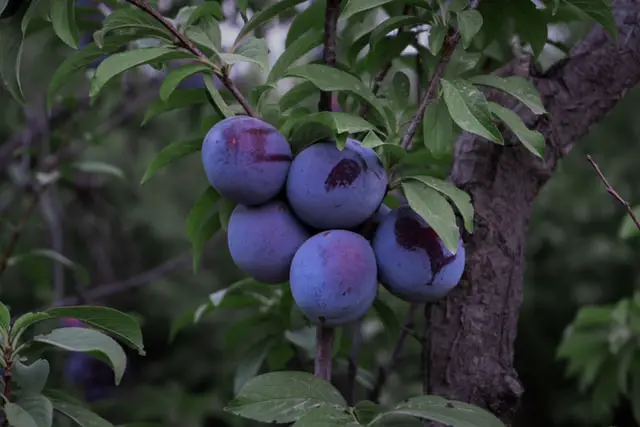
Early Spring brings us beautiful buds on trees which then blossom in wonderful shades of pink. This pretty blossom often produces juicy plums during the summer months.
They’ve become increasingly abundant in recent times and in most places you don’t have to go far to find a tree full of plums. They are fairly easy to grow, even for the beginners amongst us.
Plum fruit has many uses in the kitchen. Plum jam is one of the tastiest jams you can eat. The fruit can be used for a wide range of sauces, chutneys, wines, and you can even pickle them in vinegar. Plum trees make a great addition to your garden and will produce fruit year after year when cared for correctly.
Plum Tree Varieties
There are many varieties of plum trees available to grow in the UK. They all have different features and uses for eating and cooking. Some tree varieties produce fewer plums which may suit you if you want them as just a fruit rather than a cooking ingredient.
Below we bring you our guide to the common varieties of this particular fruit to help decide which plum tree will be best to buy.
Damson
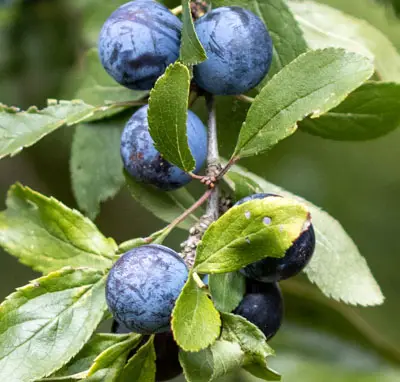
Damson plums are oval and are one of the sweeter plums making them a popular plum for jam-making. They are quite small in size and they actually originate from Damascus in Syria.
Damsons grow well in the UK climate which may seem surprising with its origins. They are blue-black and have a lovely taste to them when cooked, making them hugely versatile.
Greengage
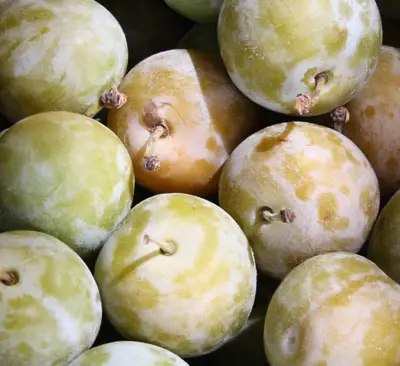
Greengage: Good to eat fresh.
Greengage plums originated from Iran and they are one of the nicest plums to use for desserts. This green plum produces one of the sweetest tastes you can imagine and it’s so very juicy.
They are often eaten fresh and also are popular with some cheese and wine. These plums can be quite tricky to grow so perhaps not for the inexperienced fruit grower.
Mirabelle
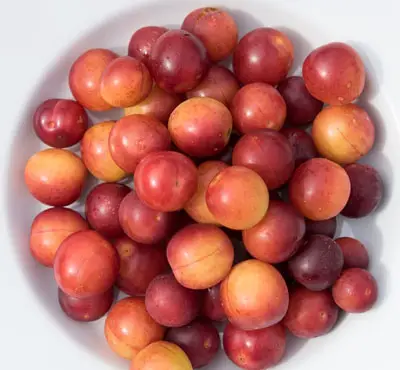
Mirabelle – Good for Jams, Cakes & Sauces
Most commonly grown in France, mirabelle plums are a small and sweet fruit often called cherry plums. These plums are a lovely yellow and are sweet, juicy and perfect in jams, cakes, and sauces.
Again, it’s not the easiest plum to grow but it can be successful in gardens.
Victoria Plum
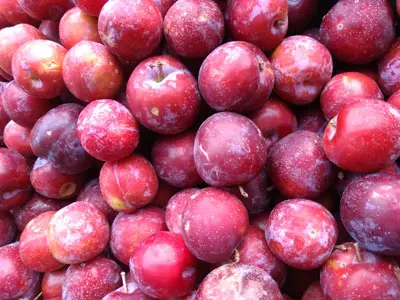
Victoria – Hardy and easy to grow.
The Victoria plum is an English plum that is red with a yellow flesh inside. The shape of this plum takes on an oval appearance and they are quite hardy plums to grow.
The name is closely linked to Queen Victoria and was thought to first be discovered in a garden in Sussex. However, this claim has been disputed over the years and its true origin is unclear.
How To Grow Plum Trees
Growing plum trees is not difficult, and they don’t require much maintenance. However, it’s still important to follow key points to ensure successful production. There are some tasks you should carry out throughout the year to ensure you get plums during the summer months.
When To Plant Plum Trees
The ideal time to plant your plum tree is late winter or early spring while trees are not yet in bloom.
This also gives your plum tree a chance to acclimatise to its environment which will set it in good stead going forwards. It’s vital to find the appropriate spot for your plum tree because if you don’t choose wisely your tree may not produce fruit at all.
Please ensure your chosen spot has the following conditions for optimum results:-
- Use sandy soil rather than clay – plum trees prefer well-drained soil and don’t do so well if the roots are very wet.
- The spot you choose must have full sun for most of the day. Anything less will not produce such good results.
- Be mindful of frosts when planting your plum tree. Plum trees flower early and are therefore susceptible to frost damage in cold spells. To avoid frost damage it’s best to try and plant on higher ground where possible.
- If you have a fairly open garden you might want to try and add some shelter before planting your plum tree. They can take quite a beating during windy weather which can affect the end result.
Pruning Plum Trees
Your plum tree will need pruning once a year to keep it healthy and producing plenty of fruit. The best season for pruning is during full growth at the height of summer. As a rule of thumb this is during June and July.
Pruning keeps it in tip-top condition and keeps it in fine shape with plenty of light being able to get through. Left without any care will see your tree become unruly and unhealthy and will ultimately lead to diseased branches.
Top Tip: Never be tempted to prune your plum tree during the winter months. If you attempt to prune over winter you risk your tree getting a disease called Silver Leaf Disease. This disease affects fruit trees and eventually kills the branches with a harmful fungus.
Pruning Tips For A Young Plum Tree:
- Carry out the first pruning session during the tree’s first dormant seasons as this encourages good growth and healthy fruit produce.
- Once planted, cut the height down to around 30 inches in height and when you make that snip be sure it’s just above a bud.
- When you make each cut be mindful this will be where there will be new growth.
- When cutting the tree back, keep the cuts clean and at an angle to prevent diseases from occurring.
- It’s important to keep a shape for your young tree so focus on 4 main branches which will provide the overall structure to your tree.
- On each of these branches, there should be just one or two buds to avoid overgrowth.
- Any other branches cut cleanly against the tree trunk.
- For the first few years try to keep the branches to 10 inches and focus on the main branches to retain a nice manageable shape.
- Once the tree is well established over 3 or more years you can allow other branches to remain. Try and encourage even spaces between branches to keep it healthy.
- The top branches should have just one bud each while the lower branches can have two buds each.
- The plum tree should take on the vase effect or Christmas tree appearance shape-wise.
- Each year take a little height off the trunk to keep the plum tree at a respectable height.
Pruning Tips For A Well Established Plum Tree
- Any dead or diseased branches need to be removed to stop the tree getting damaged. These cuts should be made flush to the trunk.
- Dead branches can be removed at any time of the year and shouldn’t be put off as the tree will be wasting valuable energy on these diseased branches.
- Be aware of any branches not producing buds as again, the tree will do better with its energy being pulled towards healthy growth. These branches can be removed.
- New shoots may start growing from near the tree roots and these should be removed when you spot them.
- Do not let the tree get too crowded, no branches should cross over with each other.
- If you are worried your tree is producing too much fruit and becoming unmanageable you can prune it during the summer to slow down the process.
Harvesting Plums
When to harvest plums: August & September
You can squeeze your plums (ooh, matron) to decide if they are ready to be picked. If they feel soft when squeezed and come off easily then you are good to go. They are best left to ripen on the tree for as long as possible to get the best out of your fruit flavours. Plums don’t keep very long once picked so be sure to eat them quickly or have plans for them in advance.
FAQ’s
Read our fruity FAQS on everything you need to be aware of when it comes to plum trees.
How Big Will A Plum Tree Grow?
The good news is that you will be able to work with the space you have available. You will be looking at a height of 2m and a width of 3m for fan trained trees. These will flourish against a south or south-west facing wall, in a large garden preferably.
For those smaller gardens, it might be best to purchase a free-standing plum tree. These will get to around 2.5m in height which is perfect for a small space.
You could also opt for a bush trained plum tree which will reach a height of around 4m. These are free-standing and you’ll need a ladder when it comes to picking the fruit. This one won’t be suitable for small spaces.
How Fast Will Plum Trees Grow?
You can expect to see fruit being produced on your plum tree between one to three years after planting. Five years after being planted you should see the optimum fruit growth being produced.
How Do You Pollinate & Do You Need Two Trees To Produce Fruit?
Some plum trees are self-fertile so in these circumstances, you will only need one. However, most will need a second tree nearby to allow for pollination to occur. If you do need a second tree make sure it will flower at the same time as the other.
How to Grow Plums From Seed
Before you get too excited about the prospect of being able to grow plums from seeds, it’s important to be realistic about the results. You may not produce any fruit from your tree at all and if you do, it won’t be to the quality of the plums you took the seeds from.
First, remove the pit and give it a rinse in tepid water to get rid of the pulp. You should then wrap the pit in a wet towel and pop it in the fridge so it can begin its chilling process. This will take approximately 6-8 weeks.
Once you see evidence of sprouting it can come out of the fridge and you can plant the pit and pop it in a soiled container. The soil should be around 2 inches in depth and keep it in a well-lit place and don’t over-water.
Once the frost has gone you can plant the seed outdoors in your desired location and it needs at least 6 hours of sun daily. The pit should be placed in a hole around 12 inches deep and keep the area well-watered.
Further Reading
- Our guide on the best plum tree for a small garden.
- Got too much fruit? Our guide on what to do with a plum glut will give you some delicious ideas to use up that excess.
- Got a problem with your plums? We can’t have that! Read our guide to all those pesky plum tree pests and diseases for help with identification and treatment.

My Victoria plum tree was overflowing with plums last year but hardly any this year. Is that normal?
I have a friend with a plum tree that has a heavy crop of ripe fruit throughout June. This is obviously very early. Its a dark blue plum, very sweet. Any idea of the variety.
We have a Victoria Plum which is 15 to 20 years old, 2 years ago we had a brilliant crop, last year we had just a few and this year we have a lot of very small ones which seem to be changing colour but not ripening and then dropping off the tree. Has the tree come to the end of it’s lifespan or is it just reacting to the changing climate?
We have a plum tree but I do not know what variety as it was there when we moved in 15 years go (SW Wales). This year, the plums are a nice size and some have started to turn a purplish colour as they always do. However, some have a clear sticky substance on the outside of the plums. The green ones do not have this, only the ones turning purple. The tree is very tall, estimated 17-18 feet high. I intend pruning it down, by 1/3 required each year, which is what I believe to be correct way. Any idea about the sticky substance please?
We have a plum tree but I do not know what variety as it was there when we moved in 15 years go (SW Wales). This year, the plums are a nice size and some have started to turn a purplish colour as they always do. However, some have a clear sticky substance on the outside of the plums. The green ones do not have this, only the ones turning purple. The tree is very tall, estimated 17-18 feet high. I intend pruning it down,by 1/3 required each year, which is what I believe to be correct way. Any idea about the sticky substance please?
For the last few years my victory plum tree .goes on a growing Spirit in the summer . It grows about 1.5 m in the summer and does not produce any fruit . I have had very little fruit from this tree In the past . Why does the tree grow in summer when it should be producing fruit , do I need to shock the root system and cut around the base of the tree about a metre away from the trunk . Any advice on resolving this problem would be very helpful because the fruit are very delicious but sparse ..
My plum tree is smothered in fruit this year but the leaves are curled and were very brown in places. Someone told me all fruit trees are suffering this year because of the extremely hot Easter followed by cold weather. Should I just leave well alone ; can send photo if you want
hello, the birds ate my plums when they first came out can you make the tree reset fruit or to late for this year
Hi, A large number of the leaves on my plum tree have not developed properly. They are tiny and the leaves are bumpy. What has caused this? The tree has been growing successfully in a large tub.
I have a patio plum tree and lots of plums but they have gone flat and shrivelled what can I do? Can I send picture?
Our Victoria plum tree has had lovely blossom and lots of plums but some of the tree hasn’t many leaves,what could be the cause of this.
I have a young plum tree, last year we had a few plums. But this year there are quite a few but they are mishaped,flat and yellow Why has this happened, any advice would be grateful
I have two mature plum trees in garden. each year the yield of fruit is pretty good but every year as the flowers start to come through, the local pigeon population take turns to sit in the tree and peck at the flowers. This year I decided to try putting a net, mesh sized approx. 1cm over the trees as the flowers started to appear. This has certainly stopped the pigeons but not the leave seem constricted. should i remove the net again or will the fruit come along as usual ? Thanks in advance for your thoughts .
Hi, I planted a Plumtree (Czar) last September and we are now in mid April and it is still not showing any signs of leaves. Is it dead? Or should I wait longer?
Hi i have bought a victoria plum tree online and it has just arrived, it looks like a straight stick no branches etc , it is my first time buying one of these, is this how it should look ,it is about 4ft tall , discription said bare root ready to fruit?
I work for a client who has a green gage and a golden gage they’ve been in a few years since 2012 and the golden and green gage havent had fruit in that time since ive been gardening for them
I bought a plum tree today, Opal, and it has thorns. Is this usual for an Opal plum tree?
I bought a mature plum tree from a nursery a year ago. I say “mature” because its trunk is approx. 8 inches in diameter. It produced one plum this summer and then started exuding brown globules of a sticky, glue-like substance. I have had conflicting opinions ranging from “this is normal” to “your tree is dying” from various sources. I’m happy to send you a photograph if this will help. Can you enlighten me?
I bought a plum tree from the local garden centre about 2 weeks ago it’s about a 9-12 months old and we have kept it in the pot as we were going to plant it in the garden on Saturday on my daughter first birthday over the past few days however the leaves have all turned yellow/brown and are falling off I’m sure this is too early for the autumn fall so I’m worried that it’s dying… It’s in a well sunlit area shielded from the wind by a hedge that perimeters the garden and I’ve been giving It water occasionally
@Keirren – Do a small scratch test. You can scratch the bark of the trunk of the tree, just a small amount. If you scratch away the bark and the wood beneath is not green, then your tree is on its way out or dead. Trees in pots need a lot of water – it could be that you have starved it if you have only given water occasionally. It would explain the sudden loss of leaves.
I have a plum tree Ive had 4 many years n it hasnt flowered or produced fruit last year I had very small green fruit but wasnt big enough n its never ever flowered Opposite I have a discovery apple tree which is doing very well The plum tree nothing is happening to it it looks very healthy though I dont really have any idea b cause Im not a gardener I bought the tree as it blossomed wen my cat died n it stands in her honour My apple tree is because of another cat I thought as the apple tree was doing so well that Id try a plum tree but Ive had the tree a long time no blossom or fruit
I have a plum tree in the garden 3 years old and this year when just picking a few off which were ripe they have brown specs inside, I picked some off the not so ripe and inside they are the same, outside no problem They have been watered well during the drout,, can they still be eaten and what is causing this?
@Cobra – If from the outside the plum looks OK (or there may be a small brown mark on the skin), then it could be the plum sawfly.
My plum tree is covered with fruit for the first time.I have been advised to take off the not yet ripe fruit now to obtain a better yield next year, is this right?
@Nico21 – The tree has only so much energy to use to produce fruit so thinning (removing some of the fruit) is essential to produce a good crop. But it’s usually done earlier in the year and for the present year’s crop.
Just picked some Victoria plums from the garden but when cut open they have brown specs inside. What is this? Can they still be eaten? Thanks
@Jan-I’m afraid to say your plum has been invaded by the plum moth and the brown flecks are the excrement of the maggot that may still be resident. (One reason not to preserve plums whole as you may be preserving more than you bargained for). If you aren’t put off eating them completely you can cut away the damaged/dirty areas and eat the remainder but it is one hell of a faff!
@Jan – it could also be plum sawfly. If there is a brown dot on the plum itself that it due to the pest burrowing inside. You’d have to research how to control it. It’s not easy 🙁
Hi, we have a Victoria Plum tree in the garden, which has these last 6 or 7 years produced loads of blossom but the fruit is very small and purple. It still tastes of plum but they are so small. We live 1/4 mile from Buncefield Oil Depot which blew up December 2005 and before this and for a few years after, apart from 2006, the tree was heaving with fruit. I was giving them away. I do believe that the explosion affected the tree as the following summer the fruit were purple black and small, much as they are now. Does anyone have any ideas please on why it won’t produce lovely golden and red plums anymore? Thank you!
The plums on my tree are shrivelling up and dropping off. They appear to be ripening but then drop off. Some of the fruit is still green and plumping up nicely but the majority are purple and shrivelled. I thought it might be due to the dry weather but even though I have given it a good soak I’ve seen no improvement. Any advice dreadfully received Thanks
@Woody – it might be about the variations in the water supply available at the roots. Hard to say really. the most important thing is not to waterlog the tree, but to keep water more constant if you can (if the tree is in a pot).